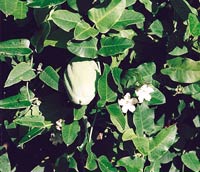
- A fast-growing, vigorous, perennial climber with milky sap and
twining, scrambling stems which are downy and flexible.
- Dark green, thick triangular leaves are up to 120 mm long. They
are smooth on the upper surface and downy underneath.
- The flowers are pinkish in bud, then white. They are bell shaped,
perfumed and have five petals with their tips turned back.
- Large pear-shaped distinctive fruit up to 100 x 70 mm. They
are fleshy green at first but ripen and dry to a rough cardboard-like
texture then split open to release the many black seeds, each
7-8 mm long and equipped with a large pappus (a hairy "parachute"
for wind dispersal).
- The plants are self-fertile and readily set seed. The rhizomes
also spread rapidly.
Control:
- Pull out young plants, do not allow plants to flower or set
seed pods.
- Collect and destroy any pods which appear.
- For small infestations, cut stem (avoid the sap) and immediately
apply herbicide. Spray larger infestations with herbicide eg.
Metsulfuron which may affect host plant.
- Check for regrowth.
THIS PEST PLANT IS BANNED FROM BEING SOLD, PROPAGATED AND DISTRIBUTED.
|