|
|
|
 |

|
|
 |
|
|
 |
|
| Old man's beard (Clematis vitalba) |
| Family: Ranunculaceae |
| Description: |
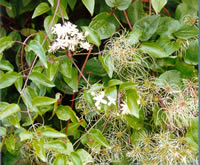
| Old man’s beard is a woody, perennial climber up to 25 metres high. The stems have length-wise ridges and can grow many metres each year. In summer or early autumn it has small white flowers with four petals. The resulting whitish, fluffy seed heads are very noticeable in autumn and winter. Old man’s beard loses its leaves for winter. The leaf spike has five leaflets except on seedlings which have one to three leaflets on each spike. |
| Other names: |
| Traveller's joy, wild clematis. |
| Values at risk: |
| Ecological values are at risk as old man’s beard competes with, and smothers desirable plants in all types of bush, in urban gullies, in forests and in riparian margins. |
| Strategy rule: |
|
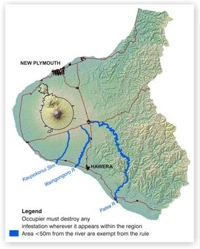
You must destroy all old man’s beard on your property except on land within 50 metres of the rivers shaded blue on the map, where control is voluntary. |
| Biological control: Old man’s beard is widespread in the three catchments shaded blue on the map (the Kaukokonui, Waingongoro and Patea). In these problem areas, the Council has implemented a biological control programme to reduce infestations over time and make the problem more manageable. |
| Note that native clematis flowers in spring and is evergreen and so does not lose its leaves in the winter. |
| How to destroy: |
Hand pull or dig out young vines or seedlings. Take care to get all the main root system out and to collect all seed heads you can reach and stems, which can regrow if left on the ground. Use a herbicide. Using herbicides to control old man’s beard is very effective if the correct timing and rates of application are used. Always follow the manufacturer’s directions on the product label and avoid spraying if it will rain before the spray is rain-fast. The rain-fast times for herbicides vary widely by up to five hours so it pays to check, rather than waste spray. For heavy infestations growing up trees, cut the vines at waist level so no hanging stems are in contact with the ground where they can regrow. Take care not to leave stems touching the ground. Carefully dispose of any seed heads you can reach. Leave the hanging stems to dry out if dragging them down will ruin the supporting tree. After cutting the stems, immediately apply stump treatment with a herbicide gel or wait for the cut stems to regrow then spray the new leaves with herbicide. For heavy infestations on low-growing vegetation, spray the whole vine when in full leaf. Note: serious infestations of old man’s beard will not be eradicated in one season. Seedlings and regrowth will need follow-up treatment.
|
Click on image for larger picture